Draft CMDA Strategic Action Programme (SAP) for the CMDA underway
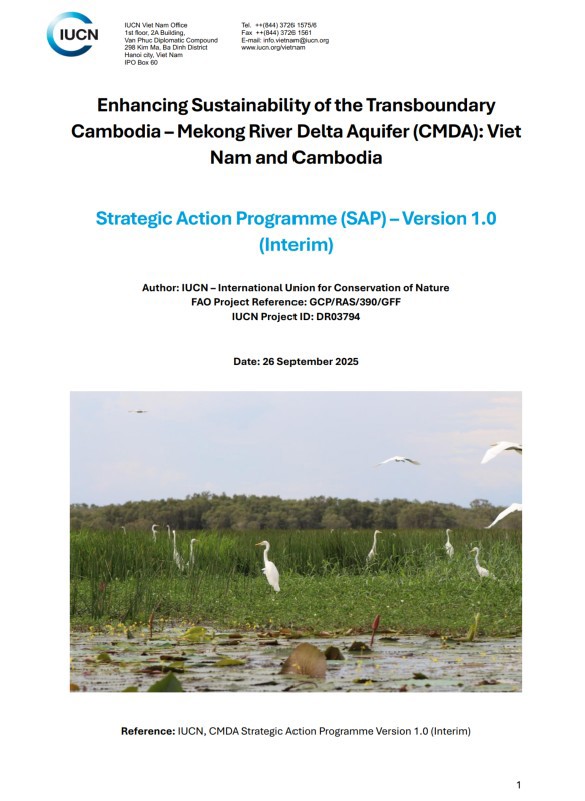
The Cambodia–Mekong River Delta Aquifer (CMDA) project has reached an important milestone with the internal completion of Version 1.0 (Interim) of the Strategic Action Programme (SAP) by IUCN, the project’s lead executing agency.
The SAP is the CMDA’s central governance framework. It will provide Cambodia and Viet Nam with a shared roadmap for long-term, coordinated groundwater management. This interim draft marks the first step in what will be an iterative and participatory process of refinement with governments and stakeholders.
Version 1.0 places groundwater storage and quality at its core, reflecting the reality that over-abstraction, saline intrusion, subsidence, and contamination are interconnected challenges that threaten the delta’s resilience. The draft SAP outlines approaches to:
-
Enhance monitoring and data-sharing across the transboundary aquifer.
-
Pilot technical and nature-based solutions, including Managed Aquifer Recharge (MAR).
-
Strengthen policy and institutional alignment so surface water and groundwater are managed as one system.
-
Ensure inclusivity, using UNESCO WWAP gender tools to embed gender and social equity into aquifer governance.
This internal draft will be shared with governments and partners in Q4 2025 for structured review and feedback, with further refinements to follow. Successive iterations (V1.1, V1.2) will incorporate findings from the ongoing Transboundary Diagnostic Analysis (TDA), pilot projects, and stakeholder consultations, leading toward Version 2.0 in 2028.
“This interim version is a scaffold,” noted Bob Bower, outgoing CTA of the CMDA project. “It will be reshaped by evidence, dialogue, and the knowledge of the people of Viet Nam and Cambodia who depend on this aquifer. Our hope is simple: to hold more water safely in the ground—cleaner, longer, and in balance with the rivers above.”
The next step is a partner and government review cycle through late 2025 and early 2026, which will guide the further development of the SAP into a durable, jointly owned framework for aquifer cooperation.