Exploring Managed Aquifer Recharge for groundwater sustainability in the Mekong Delta
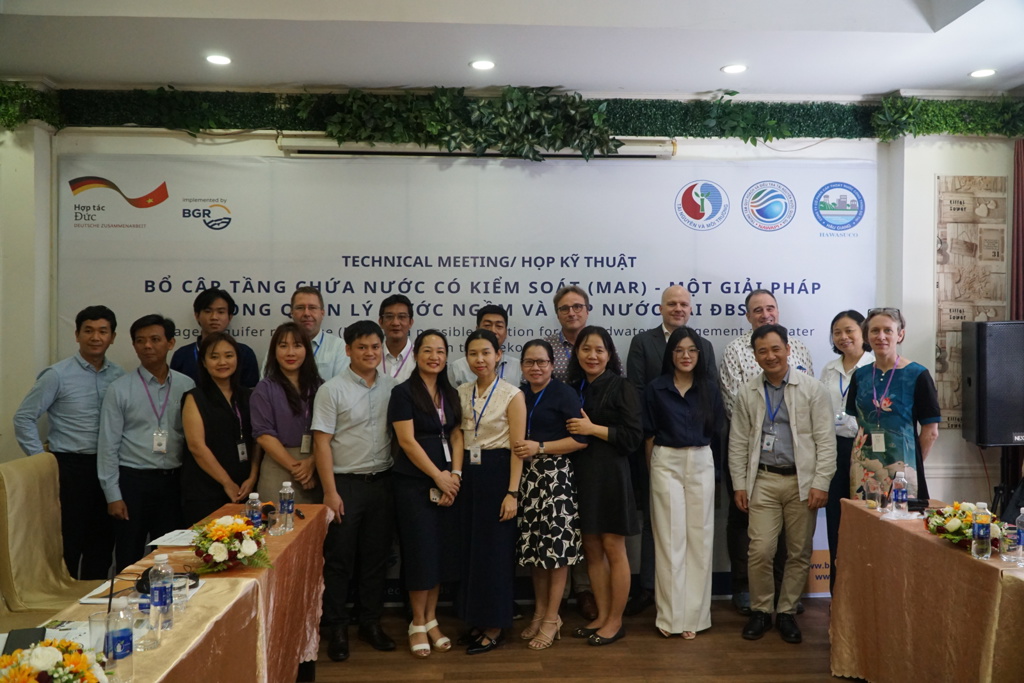
Participants reviewed previous projects’ results in Hau Giang piloting MAR effectiveness in replenishing groundwater and improving water security such as the Climate Resilient Management of Groundwater and Geohazards (CRMGG) and Domestic Freshwater Supply for the Mekong Delta (DFSMD) initiatives. Discussions explored the regulatory frameworks, feasibility, and challenges of scaling up MAR solutions, reinforcing the urgency of implementing science-based approaches to sustainable groundwater management.
The Mekong Delta suffers from declining groundwater levels, saline intrusion, arsenic contamination, and land subsidence. IUCN and FAO are implementing and executing respectively the GEF project Cambodia-Mekong Delta Aquifer (CMDA) to address the transboundary groundwater challenges between Cambodia and Viet Nam through improved governance, scientific research, and pilot implementation of MAR solutions.
At the workshop, the IUCN presented the CMDA, focusing on draft Strategic Action Plan (SAP) for Sustainable Groundwater Management, IUCN’s approach to integrate MAR into sustainable groundwater management, and its support for scientific collaboration between Viet Nam and Cambodia.
The session highlighted how MAR can play a critical role in stabilizing groundwater levels, mitigating saline intrusion, and ensuring long-term water security in the transboundary aquifer. The workshop concluded with a commitment to integrate MAR into groundwater governance and for further collaboration and policy development across the Mekong Delta.